


June 11, 2018 |

The email marketing “sweet spot”

Stay in the Loop

Get practical marketing insights, branding tips, and growth strategies delivered straight to your inbox.

Subscribe

EXECUTIVE SUMMARY: Figure out your cadence, stick to it, and then pass activities on to teammates. Kung Fu for email.


Email marketing is a great, low risk tool to actively reach out to your audience and increase your brand awareness, sales, and customer engagement. We actually use email for our own marketing efforts at Relish because it’s deemed to be a “no-brainer” platform for a number of reasons: we have a qualified list, who is fairly used to receiving – and opening – correspondence from us and email is a relatively low-cost mechanism of connectivity. Plus, did we mention, it’s easy.


Since email correspondence is WAY more efficient than many other forms of engagement, we put together some great materials to help deliver important and valuable information to move your marketing efforts forward. If you aren’t on our current email list to receive these updates, we’d love to have you join us.


Your business can see positive growth and impact using email marketing, however, we know that starting an actual email marketing campaign can be VERY challenging. To aid you, we are sharing the low-down on email marketing and some of the challenges you need to overcome (or pitfalls to avoid) when leveraging email to engage with their customer base.


EMAIL MARKETING 101


In its most basic form, email marketing is a tool that businesses can use to help engage their customers in a non-obtrusive way. At best, email correspondence is an inexpensive means to deliver value to your customers, to stay top of mind, and to continue to engage with your customers in a conversational way.


Email offers a variety of conversation opportunities with your customers:


  • Educational Resources
  • Updates and announcements of information
  • Offers, Deals, Discounts exclusive to the mailing list


Like most marketing activities, there is no one right way to do email marketing.


For some businesses, a polished, newsletter-style email will produce effective engagement opportunities. For others, a well-written, text-only email will look more genuine and authentic. Often, a combination of the two mechanisms is effective.


Understanding the needs and motivations of your customers is the best place to start when deciding which style of email you should send. It’s simple to learn these preferences.Ask members of your email list what their preferences might be. This interaction also solves a dual purpose of deepening your customer relationship.


Another great place to start in terms of style is to review (and collect) emails you receive to determine what has worked on you. Understand what techniques or tactics these businesses used to get you to click or read their emails and apply that to your target audience’s needs and wants.


*(Many times we focus on what works on us when we, ourselves, are not our own best audience.) What have you liked about emails you have received in the past? What don’t you like?


How often should we send?


One big question that any business struggles with in their email engagement plans is:


“How often should we send an email?”


Unfortunately, there is no single right answer.


A report from Smart Insights found that there is no one golden email frequency metric that works for all businesses. In fact, frequency varies from industry to industry and business to business. The only correlation they found was that to be most effective, all email content should be relevant and purpose-driven. Irrelevant or low quality emails can damage your brand and increase the number of unsubscribers.


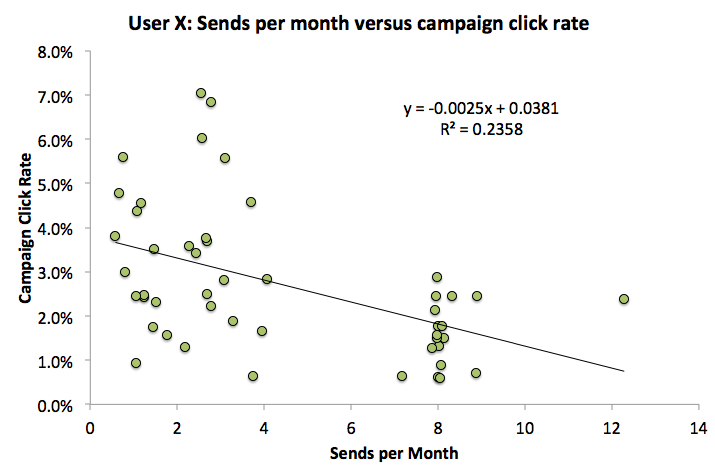
Another study conducted by Mailchimp (who sends an average of 600 emails per day for 9 million different clients!) discovered a direct correlation between click rates and cadence. The metric Mailchimp uses for engagement is “click rate” and the data are rather eye opening:

Scatter plot: Campaign click rate vs. sends per month for User X, showing a negative correlation.

As the frequency of emails increased, the engagement decreased significantly. This study shows that a quality over quantity approach is much more effective for email marketing campaigns, as long as it includes high-value content.


“The Sweet Spot”


Long story short, there is a direct correlation between the frequency of emails sent to your customers and the open rate and engagement rates. Certainly, this correlation has a tipping point where too much becomes less effective (when you cross over into “spammy” mode) but establishing a consistent cadence is certainly the way to go when embarking on an email campaign.


Email marketing company Campaign Monitor did an extensive study into email marketing sending frequency, comparing multiple reports from multiple sources, and found that the “sweet spot” between interaction and unsubscribing fell around 2 emails per month with sharply diminishing returns after 4-5 emails per month.


Relish’s own email marketing campaigns currently follows this formula and we send out two emails per month intended to create engagement with blog posts (like this one!) or a resource recipients can use to better improve their businesses. Following this formula, we have recorded double the open rate of industry averages with our reengagement audience and almost 5 times higher open average rates with our active customer list!


Adding Value


No matter the frequency of your email, we recommend that all of your correspondence offer value in some fashion. This doesn’t mean you can never “ask” your audience for a sale, but the cadence on these types of emails should be way slower than your regular, value-add contacts.


At Relish, we strive to follow a system of engagement wherein we provide consistent value throughout each correspondence with only occasional “hard asks” or sales engagement activities. Certainly, we would encourage some sort of call-to-action on every email, but most of these should be “softer asks” such as:


  • Workbooks or downloadable tools
  • Feedback and opinions (including short surveys)
  • Links to more, in-depth information (hopefully on your site)
  • Sharing opportunities


If you can create a relationship where your customer sees you as a trusted advisor in their space – the most knowledgeable person on a subject – then you are on your way to a successful engagement. When you offer them something to buy they will be more likely do so because you have proven you know how best to help them and the product or service you are now offering is the correct solution to their problem.


Measuring Success


The final component of a good email marketing campaign is measurement. There are a variety of ways to measure the success of your email campaigns. Typically, we recommend tracking several KPIs for any campaign to be able to effectively gauge its success:


  • Open/click rates of each email
  • A/B Test subject lines, content, and design with random control groups in your mailing list
  • Measure the open rates as compared to your content calendar and subjects you discuss with your customers
  • Compare the success of your email campaigns to your goals (conversion, sales, etc).


For an in-depth study on how to successfully set up testing and measurement for your own email marketing campaigns, check out this blog post from Zapier.


To assist you in measuring your own email marketing campaigns, we have created a FREE EMAIL MARKETING PLANNING TEMPLATE that will allow you to plan a email campaign as well as measure and track its success.

Remember, email marketing is about your audience and customers. It’s about keeping the lines of communication open so that you and your business are top-of-mind when your audience is ready for your product or service.


Do you need some help with your email marketing campaigns? Having a hard time setting up your goals or how to develop the tools to measure success?


Set up a phone call request here and we can help you out.

Thoughtful strategy. Practical execution.

Clear thinking, honest perspectives, and experience shaped by years of doing the work. No shortcuts, no borrowed opinions, just lessons learned by showing up, solving problems, and following ideas all the way through.

Hands holding a tablet displaying a video player interface. The video is paused.
February 20, 2026
In case you hadn’t seen these (and also for my friends at Adventure Film ), here are a couple of must-see running movies from Joel Wolpert:  Geoff Roes: Slogging to the Top

Runner in blue and red gear sprints across grassy terrain, mountains in background, cloudy sky.
October 27, 2015
Guess who’s back. Back again. ~ Eminem  Still working out some kinks in the site but hoping to be more active and on the regular up in this joint. Quick catch up: 2013: NYC was a bust. I experienced a heel problem which led to a hamstring problem and I shut down my quest for an NYC finish. At least for now. The remainder of 2013 was spent trying to get uninjured. 2014: Injuries persisted in 2014. When the heel/hammy started feeling ready to run again, I broke my ankle bouldering. Literally came off the wall a foot and a half off the ground and popped my ankle. Whee. So more recovery and I pretty much switched to riding mountain bikes for the year. 2015: Back at it in 2015. Running pretty well. A bit off my game from day’s past but still having fun. Even entered a few races which didn’t go well. Just trying to figure things out and stay happy/healthy. More to come, I promise. ~stubert.
Person fixing a flat tire on a mountain bike outdoors; green helmet, tan shirt, shorts.
August 24, 2013
I hurt myself today . ~ N.I.N. Ah the Tabata. Some people hate them, others love them. In the moment, they can be the bane of my existence but after rocking out a few sets, I really tend to notice the benefits. For the uninitiated, a Tabata can be applied to virtually any exercise type (cycling; swimming; push-ups; chess, I assume) but since I am a runner, I tend to knock these out while running. Go figure. Here’s the formula: Go as hard as you can for 20 seconds Rest for 10 seconds Repeat 8 times Feel free to do multiple sets Four minutes (per set) of activity doesn’t sound like much, but if done correctly, these can really help boost your fitness. I tend to replace strides with one Tabata on Fridays and will work in multiple sets as part of my Tuesday interval training. Just keep good form, really work the 20s and you’ll reap the benefits. ~stubert.