


December 3, 2015 |

Don’t Forget the People: Persona Development Helps Target Your Business Outreach

Stay in the Loop

Get practical marketing insights, branding tips, and growth strategies delivered straight to your inbox.

Subscribe

Let’s face it, many businesses get by just winging it when it comes to business strategy. If you really want your business to take off, it’s probably worth investing some time and effort working on your business. With limited time and resources, however, where should you start to really recognize the most bang for your buck? We think a great place to invest some time to help your business grow is in persona development – identifying and getting to know your core customer.


What’s a Persona?


The first step to creating a customer or buyer persona is establishing what the heck a persona even is. Simply put (thanks to Hubspot), a persona is a semi-fictional representation of one of your core customers that help you better understand your core audiences and customers.


Personas are fictional, generalized characters that encompass the various needs, goals, and observed behavior patterns among your real and potential customers. They help you understand your customers better.


Establishing your personas will enable you to have a better understanding of the types of information you should be creating to help guide site visitors through the buyer’s lifecycle, the tone and timbre you should use when creating materials, and where you should focus your outreach efforts in order to get in front of your target audience most effectively. A well-crafted persona “comes to life” as a no-nonsense representation of your core customer – one with whom you can become more familiar the more you hone their description – which leads to an increased level of comfort and understanding that helps guide your outreach and content offers. All of this research should be people-focused rather than company-focused. The key idea behind persona development is to remind us that we sell to other, identifiable people in all our interactions. Though they may represent companies, at the end of the day, we are dealing with interpersonal relationships in all of our business dealings.


How do I develop personas?


The first step to developing personas is to create a list of questions to ask yourself and your team that will help identify the core qualities of your target audience. There are no “right” or “wrong” answers as you start persona development – all answers help hone your core audience characteristics.These representations take into account a wide range of information about your target customer, client, or buyer including:


  • Demographics: Age, education-level, income, marital-status, etc.
  • Role: This person’s role in his or her company including how their performance is measured, skills required, and to whom they may report
  • Interests: Personal and professional interests, hobbies, activities, etc.
  • Needs/Goals: What is your persona attempting to accomplish and how will they reach these goals?
  • Challenges: What obstacles stand in their way to achieving their goals?
  • Watering holes: Where they go to get information about their job. Associations and networks to which they belong. Where they turn to get answers to help them reach their goals and/or overcome challenges.
  • Shopping preferences: How they prefer to interact with vendors and where they go online to research vendors or products.
  • Company information: Revenue, employee count, industries, etc. (though again, make sure these augment the target personality and don’t get too caught up in company demographics).
  • Here is a list of 100 questions you can reference when developing personas.


As you start to answer these questions, you will begin to see trends in your answers and may even be able to identify multiple audiences for whom you can develop personas. In this case, segment your answers to identify a variety of distinct personalities with whom you should interact.

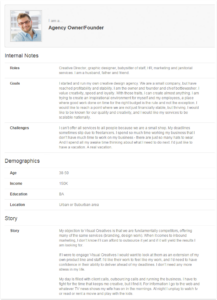
Once you have answered the questions that help build a framework for your personas, develop a story around each one that brings each character “to life”. This story should paint a very clear picture of who you are seeking to entice to visit your business. Focus the story on:


  1. Roles
  2. Goals
  3. Challenges
  4. Demographics
  5. The Persona Story
  6. Name and bio photo
A customer profile with photo of a man and details on goals, challenges, demographics, and story.

For each of these areas of persona development, more information is better than less. Keep in mind that your personas can evolve over time (as your business changes, you get more familiar with your core customers, or you just get better at developing personas!). These are not static and can change and grow often as you collect more information. The more information you can weave into your personas the better your understanding of your target audience will be – and the better you can be at crafting your outreach to entice them to become your customers.


It’s about PEOPLE


If there is one takeaway from this article, it would be to remember that you are dealing with people not companies. We often hear clients talk about companies they want to go after to help grow their businesses. There is nothing wrong with picking out some big players in your industry (company-wise) but always keep your focus on the people within that company with whom you will need to establish a trusting relationship to help land that big client. Persona development is the first step on the road to successful outreach and converting traffic to customers.

Thoughtful strategy. Practical execution.

Clear thinking, honest perspectives, and experience shaped by years of doing the work. No shortcuts, no borrowed opinions, just lessons learned by showing up, solving problems, and following ideas all the way through.

Hands holding a tablet displaying a video player interface. The video is paused.
February 20, 2026
In case you hadn’t seen these (and also for my friends at Adventure Film ), here are a couple of must-see running movies from Joel Wolpert:  Geoff Roes: Slogging to the Top

Runner in blue and red gear sprints across grassy terrain, mountains in background, cloudy sky.
October 27, 2015
Guess who’s back. Back again. ~ Eminem  Still working out some kinks in the site but hoping to be more active and on the regular up in this joint. Quick catch up: 2013: NYC was a bust. I experienced a heel problem which led to a hamstring problem and I shut down my quest for an NYC finish. At least for now. The remainder of 2013 was spent trying to get uninjured. 2014: Injuries persisted in 2014. When the heel/hammy started feeling ready to run again, I broke my ankle bouldering. Literally came off the wall a foot and a half off the ground and popped my ankle. Whee. So more recovery and I pretty much switched to riding mountain bikes for the year. 2015: Back at it in 2015. Running pretty well. A bit off my game from day’s past but still having fun. Even entered a few races which didn’t go well. Just trying to figure things out and stay happy/healthy. More to come, I promise. ~stubert.
Person fixing a flat tire on a mountain bike outdoors; green helmet, tan shirt, shorts.
August 24, 2013
I hurt myself today . ~ N.I.N. Ah the Tabata. Some people hate them, others love them. In the moment, they can be the bane of my existence but after rocking out a few sets, I really tend to notice the benefits. For the uninitiated, a Tabata can be applied to virtually any exercise type (cycling; swimming; push-ups; chess, I assume) but since I am a runner, I tend to knock these out while running. Go figure. Here’s the formula: Go as hard as you can for 20 seconds Rest for 10 seconds Repeat 8 times Feel free to do multiple sets Four minutes (per set) of activity doesn’t sound like much, but if done correctly, these can really help boost your fitness. I tend to replace strides with one Tabata on Fridays and will work in multiple sets as part of my Tuesday interval training. Just keep good form, really work the 20s and you’ll reap the benefits. ~stubert.